Pharmacy POS System: How to Choose in 2026
A pharmacy isn't run like a corner shop. Behind the counter, every product has a batch, an expiry date and, often, regulation attached to it. Selling the wrong batch, letting expensive stock expire, or losing track of customer credit are all straight losses, and for an out-of-date medicine, a real safety risk. So your pharmacy POS system has to do far more than take payment: it has to protect your stock. Here's how to choose, with a focus on the realities of pharmacies in emerging markets.
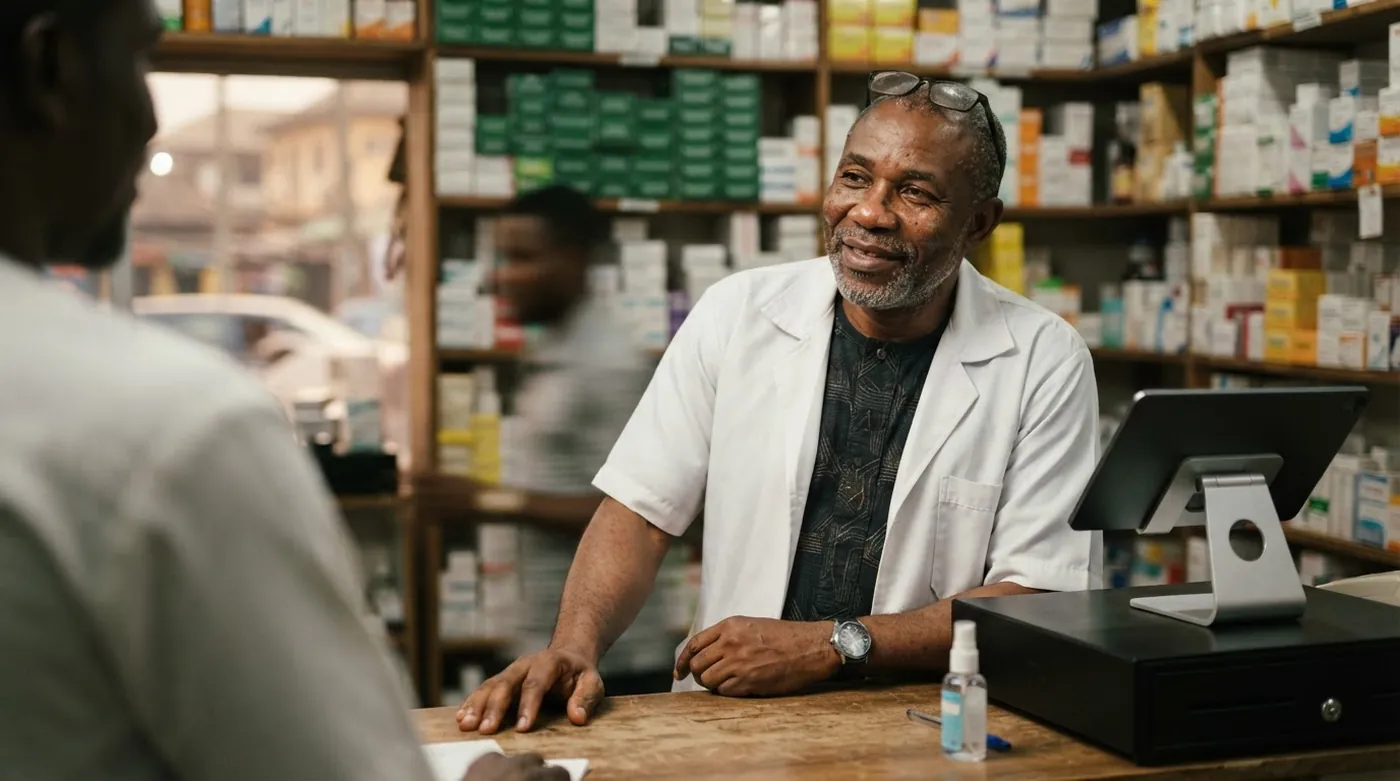
What a pharmacy really needs from a POS
A pharmacy combines the constraints of retail with those of a healthcare business. These are the functions that genuinely make the difference at the counter. If you trade in the Philippines or elsewhere in the region, our guide to the generic-name rule and what it demands of your software covers the same ground under local law.
Related reading: POS contract lock-in, best free POS systems, and cash flow management.
Batch and expiry-date traceability
This is the heart of the job. Every medicine enters stock as a batch with an expiry date. The POS must track quantities batch by batch, know which one goes out first, and warn you before a batch expires. Without this traceability you can't run a proper batch recall, or avoid expired write-offs.
Expiry alerts
A good system warns you weeks in advance that a batch is nearing its limit. You can then push it, return it to the wholesaler where possible, or pull it. These alerts turn a silent loss into a managed decision.
Barcode scanning (and the molecule)
Scanning a box's barcode or Data Matrix identifies the product, its batch and its expiry in a second, no more manual entry and its errors. Better still: with an integrated drug database, the scan goes all the way to the molecule (INN) and suggests generic equivalents, a major asset for safe dispensing and counter advice. This is exactly one of digabloPos's strengths, whose scan identifies the medicine's molecule.
Customer credit (account / tab)
In many neighbourhood pharmacies, customers pay in instalments, or a third party pays for them. A POS that handles customer credit, a real account in the person's name, lets you track what's owed cleanly and avoid losses, while keeping your clientele's trust.
Offline mode
Where the connection drops, the pharmacy can't stop selling. A true offline mode keeps the POS and stock working without a network, then syncs the data as soon as the connection returns.
Stock, thresholds and orders
A pharmacy carries a large, expensive inventory. Threshold alerts ("5 boxes left") and real-time tracking prevent stock-outs on fast movers and cash tied up in slow ones.
FIFO, FEFO and batch tracking: the difference that counts
Two stock-rotation methods come up again and again:
- FIFO (First In, First Out): you sell what came in first. Fine for ordinary retail.
- FEFO (First Expired, First Out): you sell what expires soonest, whatever its arrival date. This is the golden rule in pharmacy and for any perishable product.
A box received recently can expire before an older one: only FEFO, backed by batch tracking, guarantees you dispense the right one. A POS that applies FEFO automatically cuts both waste and the risk of handing over an expired product.
The right reflex: insist on a POS that tracks batches AND applies FEFO. Plain "stock tracking" isn't enough in a pharmacy.
The context of pharmacies in emerging markets
For a pharmacy in markets across Africa, Southeast Asia or Latin America, three realities often outweigh everything else:
- Unreliable connectivity, hence the critical importance of a dependable offline mode with sync.
- Customer credit, instalments and neighbourhood trust are the norm; the POS must track customer accounts flawlessly.
- Remote oversight, the owner isn't always on site; being able to watch sales and stock from a phone limits shrinkage and gives visibility.
Add to that multi-currency handling in some regions, and the need for a simple tool that several staff can pick up quickly. Tax compliance, meanwhile, depends on the country: check your local obligations before choosing (what applies in one country doesn't transfer as-is to another).
How to choose: 7 criteria
- Batch tracking + FEFO: the absolute priority in a pharmacy.
- Expiry alerts, early and configurable.
- Barcode / Data Matrix scanning for error-free recording, ideally to the molecule.
- Customer credit / account for instalment payments.
- Offline mode with automatic sync.
- Stock alerts and real-time tracking, accessible remotely.
- Controlled real cost: a clear plan, no forced commission or surprise modules; tax compliance suited to your country.
Our recommendation
digabloPos
digabloPos ticks the boxes that protect a pharmacy. The base plan is free forever (no time limit, no credit card), and it leans on what matters at the counter: a barcode scan that identifies the molecule (INN) and generic equivalents, stock management with batches and expiry dates, customer credit for instalment payments, and a true offline mode that keeps the pharmacy running when the connection drops. Remote sales and stock oversight helps curb shrinkage, a real plus for an often-absent owner. You add pay-as-you-grow modules only when needed.
👍 Strengths
- Free forever, no commitment
- Scan → molecule (INN) & generics
- Stock, batches & expiry tracking
- Customer credit (instalments)
- Offline mode + sync
- Remote oversight (anti-shrinkage)
- Modular add-ons, multi-currency among them (about $10/month)
👎 Notes
- Newer brand than sector incumbents
- Tax compliance depends on your country
- Some advanced modules are paid
What puts digabloPos first for a pharmacy is the alignment between an officine's needs, a scan that identifies the molecule, stock safety, customer credit, offline mode, remote oversight, and the absence of forced costs. For tax obligations, which vary by country, confirm the exact scope against your local rules.
Want to test it in your pharmacy?
The base plan is free forever, ready in 5 minutes, no credit card.
Try digabloPos freeSummary table: key pharmacy functions
| Expected function | Why it's essential in a pharmacy | digabloPos |
|---|---|---|
| Batches & expiry dates | Traceability, batch recalls, no expired product sold | Yes |
| Automatic FEFO | Sell what expires soonest first | Yes* |
| Expiry alerts | Anticipate losses before the deadline | Yes* |
| Barcode → molecule / INN | Generic equivalents, safe dispensing | Yes |
| Customer credit | Instalments, neighbourhood trust | Yes |
| Offline mode | Sell even without a connection | Yes |
*Depending on active modules and how the offer evolves. Vendor features change and compliance varies by country: always verify the exact scope and local obligations on official sites before deciding.
FAQ
What is FEFO in a pharmacy and why does it matter?
FEFO means "First Expired, First Out": you sell the batch with the nearest expiry date first. It's safer than FIFO because it limits expired write-offs and the risk of dispensing an out-of-date medicine. A good pharmacy POS tracks batches and applies FEFO.
Should a pharmacy POS track batches and expiry dates?
Yes, it's essential. Every medicine arrives as a batch with an expiry date. The POS must track quantities per batch, alert before expiry and allow a recall. Without this traceability, running a pharmacy is risky and often non-compliant.
Does scanning the barcode identify the medicine?
The barcode (or Data Matrix) identifies the product, its batch and expiry. With an integrated drug database, like digabloPos's, the scan goes to the molecule (INN) and suggests generic equivalents, a real asset for safe dispensing.
Why is customer credit important for a pharmacy in emerging markets?
In many markets customers pay in instalments or via a third party. A POS with customer credit lets you track what's owed cleanly, avoid losses and keep your clientele's trust.
What happens if the internet connection drops?
With a true offline mode, the pharmacy keeps selling and recording stock movements without a network; data syncs when the connection returns. Decisive where connectivity is unreliable.
Ready to secure your pharmacy?
Set up your pharmacy POS in 5 minutes, no commitment, no credit card.
Create my free register, 5 min